About screen printing
What is screen printing?
"Screen printing" and "silkscreen printing" are methods of printing ink directly onto clothing or goods using a plate.
To create the plates, a separate plate is required for each color, so normally the plate-making fee would be several thousand yen per plate, but PRINTEEZ offers a free plate-making service for orders of 10 or more items of the same design . However, if you order 9 or fewer items, the following additional charges will apply.
When making new plates for 9 or fewer sheets: A plate-making fee of 2,000 yen per plate is required.
For additional orders of 9 sheets or less: A color change fee of 1,000 yen per plate will be charged.
*If you order using the design simulator, the above amount will be automatically added if you change the printing category. (For details, please see How to Order / Processing Fees and Additional Fees.)

Screen printing features
-This is the most common and popular printing method, producing beautiful results.
- Recommended when you need a large number of the same design.
- It is resistant to fading and durable even after washing.
-We have a wide variety of inks available, so you can print in the color of your choice.
・PRINTEEZ does not charge plate fees for additional production on a semi-permanent basis (in principle, same material/same position).
・One plate is required for each print color in one area.
・If you order 9 or less sheets, 2,000 yen will be charged per sheet.
- Processing may not be possible in some locations, such as near stitching or edges.
- With polyester products, over time, there is a possibility that the color of the fabric may bleed (reverse sublimation) onto the printed surface.
Maximum screen print size
As a general rule, the size is within W350mm x H400mm, but this varies depending on the product, so please refer to the product details.
Screen printing precautions
We recommend creating data with a fill of 1pt (0.35mm) or more and a cutout of 2pt (0.7mm) or more. Anything less than this may result in the data being crushed or not being displayed clearly. Any data submitted below these values that is crushed or blurred will not be eligible for return.
・Halftone printing is also possible, but in that case please submit the data at actual size, 300 dpi or less, and a screen frequency of 40 or less. Also, just to be on the safe side, please submit the original data before halftone processing.
- Print colors are expressed in RGB, which has a wide color gamut, on PC and smartphone monitors, but are actually expressed in CMYK, which has a narrow color gamut. Therefore, vivid colors in the RGB color gamut are replaced with approximate colors in CMYK. Also, while colors created in RGB are a combination of light, colors created in CMYK are a combination of actual inks, so the color development, saturation, brightness, etc. may be different from the color you desired. The finished color may also vary depending on the type of fabric.
T-shirt line width test


About halftone processing
If you submit a grayscale image when placing an order using the simulator, and no instructions are given by the customer, we may apply halftone processing at our discretion.

Regarding position specification
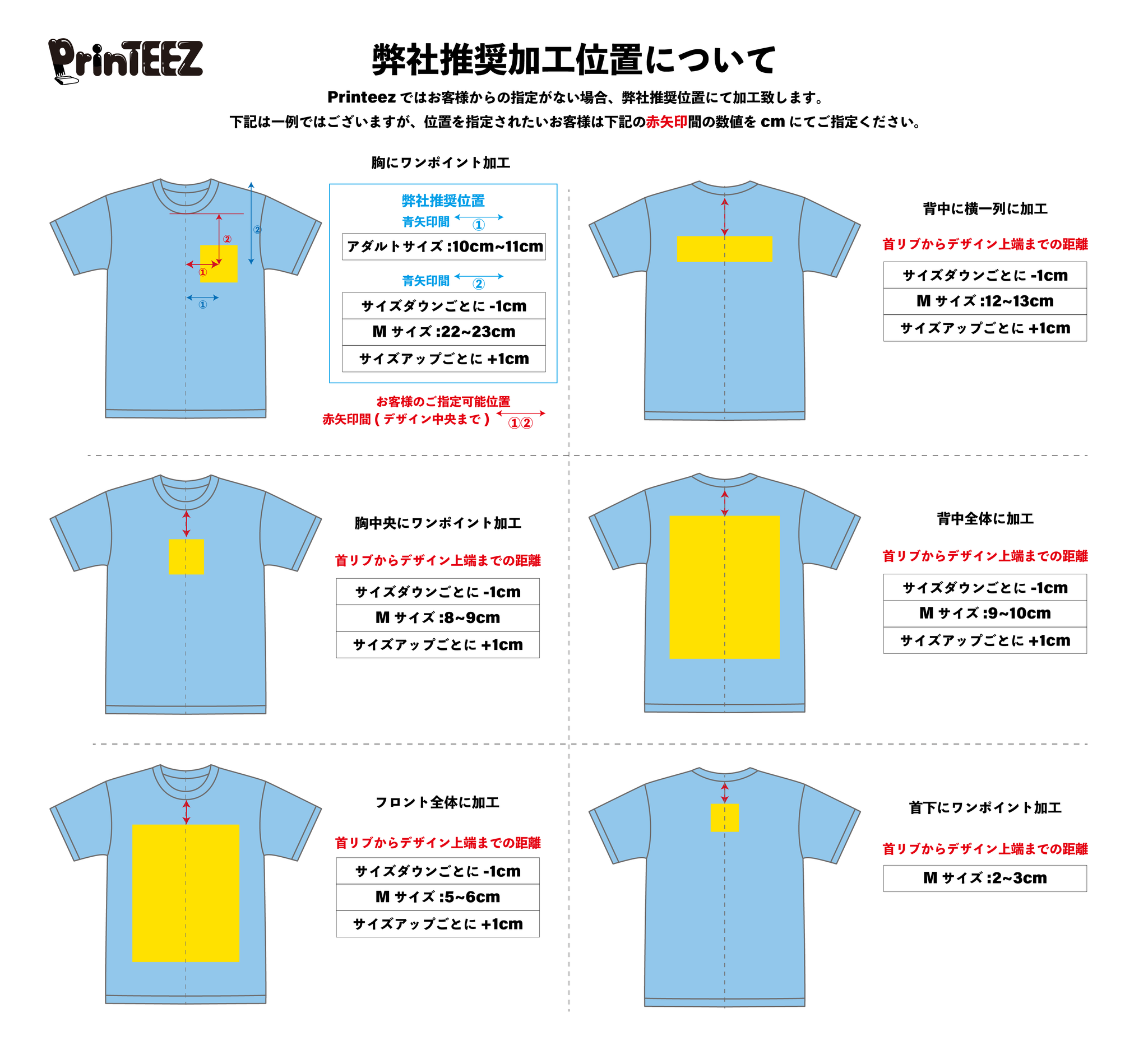
1. Regarding height specifications, for screen printing, please specify the measurement from the bottom edge of the rib at the neck. If you specify the height from the top edge, there is a possibility that the position may be misaligned due to individual differences in the rib, so returns and exchanges are not possible. If you want to specify the exact position, please specify the distance from the bottom edge of the rib.
2. Specifying the chest position
To specify the chest position, please specify the distance from the bottom of the neck rib to the center of the design, and the distance from the center of the neck rib to the center of the design in centimeters. Since the positioning is done manually, there may be a discrepancy of up to 1 cm, so please take this margin of error into consideration when ordering.
3. Regarding the processing position of the left and right edges, if you want the design to be close to the seam, please specify the measurement from the nearest seam.
4. Matching the design positions on the front and back
We do not accept work to align the designs on the front and back of a T-shirt, as this is prone to misalignment due to differences in position when laid flat and when worn, as well as individual differences.