About embroidery
At PRINTEEZ, we use computer-controlled automatic embroidery machines for machine embroidery. We do not charge for data creation fees, so you can order from just one piece. We can use a wide variety of threads, so a wide range of color variations is possible.
Unless otherwise specified, we generally embroider lines less than 1mm wide with a running stitch, lines 1mm wide or wider with a satin stitch or tatami stitch, and painted areas with a tatami stitch.
If the gap is less than 1mm, a "connecting thread" may be created to maintain (reinforce) the quality of the finished product. Even if a connecting thread is created, we aim for a natural finish by connecting the nearest points, but if you would like a finished product without connecting threads, please leave a gap of at least 1mm between designs.
Unless it can be achieved with a running stitch, we generally do not accept embroidery for designs that include line widths or gaps of less than 1mm. 


▽Features of embroidery
-Embroidery is a method of expressing designs by stabbing thread, so it is not suitable for reproducing fine designs.
- For stretchy fabrics such as T-shirts, we recommend a line width of 3mm or more (5mm or more recommended) and a cutout line of 2mm or more.
- It is highly durable and has a woven thread structure, making it resistant to wear and tear caused by washing and use, allowing it to be used for a longer period of time than screen printing or inkjet printing.
- It can be used on cotton and polyester, as well as thick materials and small items.
- There is a high degree of freedom in design, and you can even embroider personal names or initials.
・Even small lots can be produced at low cost, making embroidery easy for individuals and small businesses. However, costs may increase depending on the size.
▽About embroidery processing size
As a general rule, the shipping fee is as follows, but it may differ depending on the product, so please check the product details.
T-shirts: W80mm x H80mm
Thick items such as sweatshirts: W80mm x H80mm, W160mm x H160mm
▽Regarding embroidery frame marks
When embroidering, a special frame is placed on a T-shirt, sweatshirt, or other garment and then set into the sewing machine. We use a special frame that does not leave marks, but frame marks may remain on some items.
We do our best to remove any marks before shipping, but please note that some may remain. After receiving the product, washing the frame will almost completely remove any marks.
We also offer a laundry service for 200 yen per item. If you plan to use or sell the item immediately after delivery, please consider having it washed by us.
Please note that washing may cause some shrinkage and wrinkles. Please note that using a tumble dryer may cause shrinkage and pilling.
Regarding misalignment of embroidery position
We use a camera to position the embroidery, but there may be a deviation of 1 to 5 mm due to individual differences in the garment and the specifications of the sewing machine.
Additionally, the embroidery position on the center front (chest) is usually produced and processed based on the center of the rib at the neck (collar). However, because clothing varies from garment to garment, the center of the rib at the neck does not necessarily coincide with the center of the body width (width). Therefore, when measuring the center front embroidery design based on the center of the body width, there may be an error of up to 5 mm.
Please note that we use the rib at the neck as a reference for the embroidery position when processing the embroidery.
▽About the misalignment between the fill and the lines
・Unless otherwise specified, we will generally embroider lines less than 1mm with a running stitch, lines over 1mm with a satin stitch or tatami stitch, and painted areas with a tatami stitch.
・Letters smaller than 14 pt (approximately 5mm high) cannot be embroidered.
- Please note that misalignment may occur in designs that include lines and fills.
- The amount of misalignment is proportional to the thinness of the lines, the size of the painted area, the softness and thinness of the fabric, and the number of colors of embroidery thread used.
- Highly stretchy materials such as T-shirts are not suitable for embroidery as they have a large painted area, and this can result in misalignment or distortion of the design.
- We recommend a design with a small painted area and thick lines.
▽About crushing of fine embroidery
- Embroidery is difficult to reproduce designs exactly as they are, and is particularly unsuitable for reproducing thin lines, complex designs, pointillism, dots, gradations, and other intricate designs.
・Thick lines and simple designs are suitable for embroidery, which will result in a more beautiful finish.
- Depending on the type of thread and number of colors used in the embroidery process, fine embroidery may become crushed.
- When creating an embroidery design, it is important to create a sample and check it before processing, and make any necessary adjustments.
▽ Regarding the design
- The recommended embroidery line width varies depending on the softness and thickness of the product's fabric.
・If you wish to embroider on a non-stretchy, sturdy fabric, please make sure the line width is at least 1mm (at least 2mm if using phosphorescent thread) for a more beautiful finish.
On the other hand, if you wish to embroider on soft, stretchy fabrics such as sweatshirts, T-shirts, or socks, we recommend that you design the line width to be at least 2mm or thicker for a more beautiful finish.
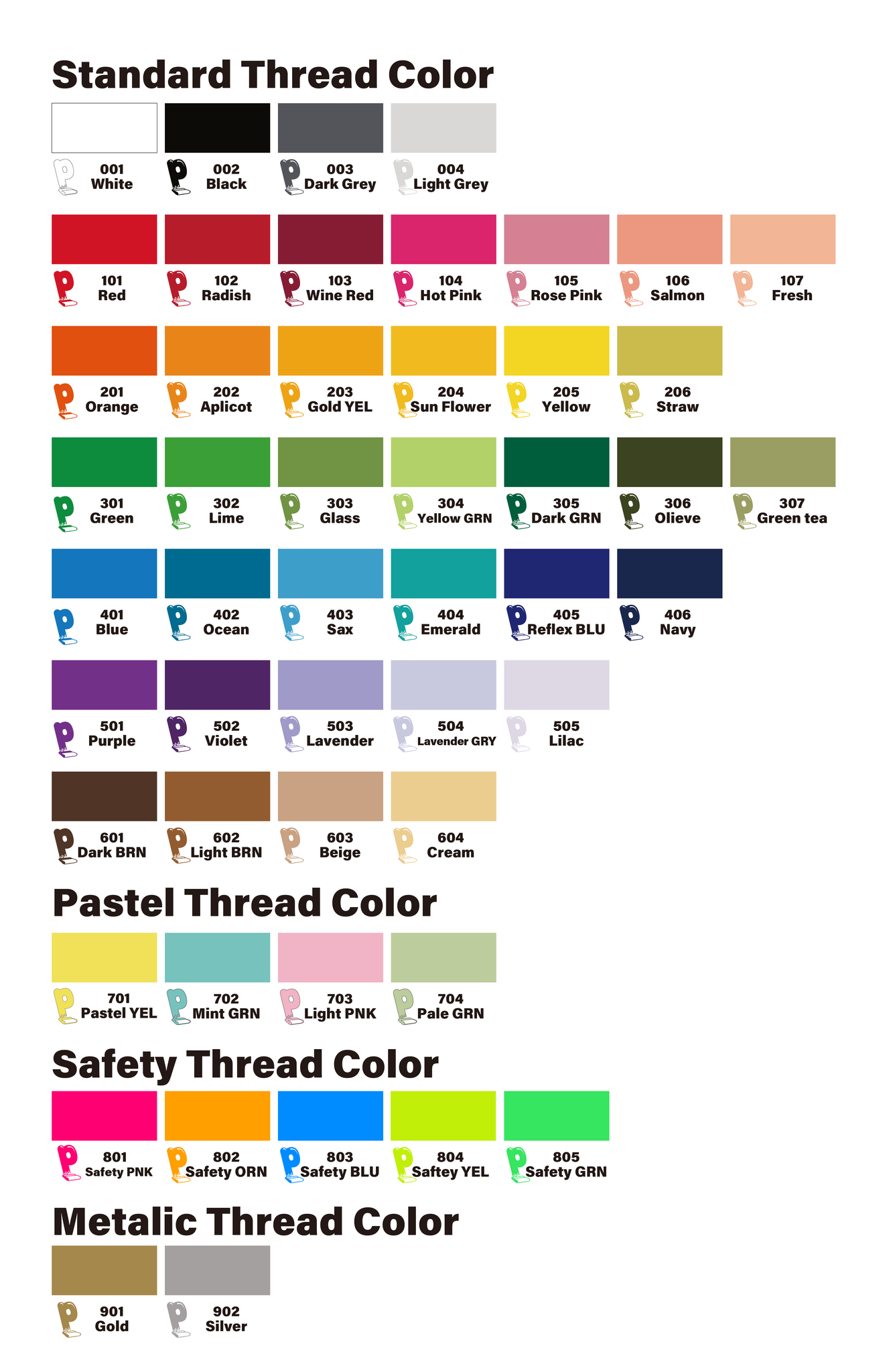
▽About embroidery thread colors
Currently, you can choose from the following five embroidery thread colors.
For the 6th color and beyond, you can add up to 10 colors (5 colors + 5 colors) for ¥200 per color.
There is no charge for changing the color of embroidery, so you can change the color of each piece individually.
We plan to add glow-in-the-dark colors in the future.